Scenario Planning as a System, Not an Event
For decades, beginning with Herman Kahn at RAND in the 1950s and later Pierre Wack and his colleagues at Shell in the early 1970s, scenario planning has shaped how organizations think about the future. What began as a way to reason through nuclear risk and energy shocks gradually became embedded in corporate strategy, defense planning, and investment research. Even as other tools for thinking about uncertainty have come and gone, scenario planning has remained in place.
There is a reason for that durability. When done well, scenario planning forces teams to confront alternative outcomes rather than quietly converging on a single expected path. It creates a shared language for uncertainty and brings assumptions that were once implicit into the open. It gives leadership a structured way to ask, “If the world moves in this direction, what would we do?” The process can be uncomfortable, but that discomfort is often productive because it exposes weak logic and overconfidence before those weaknesses show up in the real world.
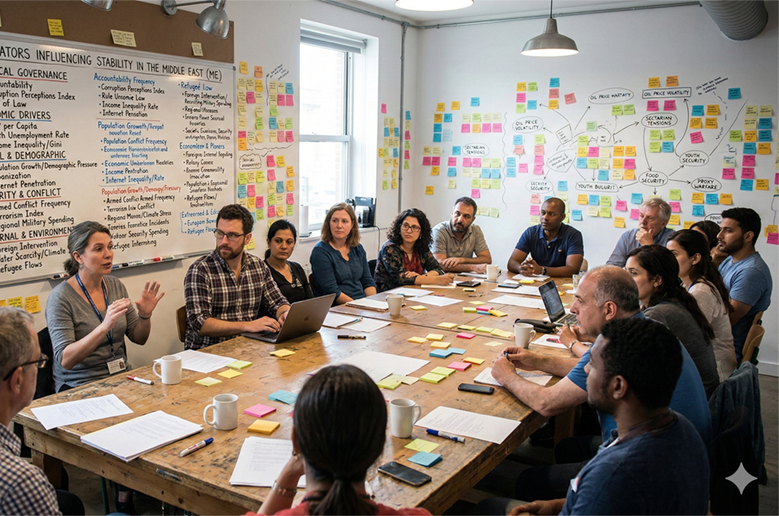
If Herman Kahn were to sit in on a typical scenario workshop today, much of it would feel familiar. The process is still largely manual and episodic. A team is convened, often with outside support. Over months, drivers are identified, uncertainties ranked, and narratives drafted. Workshops are held with senior leaders. A final report is delivered and there is a sense of completion. For a moment, the organization feels prepared for a range of possible futures. Then the project ends, attention shifts, and the scenarios begin to sit still while the world continues to change.
I recently spoke with a national security agency that had spent a year working with a university on a set of scenarios tied to a specific scientific domain. The work was serious and carefully constructed. Yet by the time the contract concluded, the technology landscape they were analyzing had already evolved in material ways. New actors had entered the field. Key milestones had been reached sooner than expected. Assumptions about capabilities and alliances were less stable than they had been at the outset. No one had done poor work, and the team made efforts to incorporate developments as the project unfolded, but once the contract ended the analysis had to be finalized and published. From that point forward, the scenarios were fixed.
This is the structural issue. Scenarios age because the facts on which they rest shift over time. Base rates move. Technical progress accelerates or stalls. Low probability, high impact events occur. Without active maintenance, the connection between a scenario narrative and current reality gradually weakens. Eventually the scenarios remain intellectually interesting but lose their operational edge.
That is where we see the opportunity.
Instead of treating scenario generation as the end product, it can become the starting point of a continuously updating system. With AI and Hinsley, coherent alternative futures can be generated quickly, but speed alone is not the breakthrough. What matters more is what happens after generation. Each scenario can be decomposed into its core drivers, and those drivers can be linked to measurable indicators. The most influential indicators can be translated into clear binary forecast questions that are updated on an ongoing basis. As the probabilities associated with those questions move, the relative likelihood of each scenario can be recalculated in a disciplined way.
Under that structure, scenarios are no longer static stories. They become hypotheses that are repeatedly tested against incoming evidence.
When this infrastructure is in place, the rhythm of analysis changes. Rather than waiting for a formal review cycle, teams can observe when the status quo begins to erode. In many cases the signal is not the absolute probability attached to a given outcome but the direction and magnitude of change. A shift from 20 percent to 35 percent may not appear dramatic in isolation, yet it can indicate that underlying assumptions are weakening. That movement is often what analysts need to surface for decision makers.
The approach also scales more effectively than traditional workshops. Maintaining even a small set of scenarios has historically required significant analyst time. If AI handles the repetitive components such as structured decomposition and indicator tracking, teams can monitor a broader range of issues across business units or regions without exhausting themselves. What was once a periodic project can become part of an ongoing operating discipline.
In that environment, the analyst’s role shifts toward interpretation and refinement. Less effort goes into rebuilding frameworks from scratch. More attention is devoted to understanding why probabilities are moving, whether indicators are well chosen, and how changes in one driver affect the broader picture. The work becomes more centered on judgment and synthesis.
There is also a methodological benefit. A structured system can follow the same analytic steps each time, which reduces drift and makes reasoning more transparent. While no system can eliminate bias entirely, especially given the realities of training data and human inputs, it can create a more consistent baseline. Analysts gain a persistent challenger that can surface missing drivers, question assumptions, and flag when a model appears too internally tidy.
The financial implications are significant. For companies, earlier detection of meaningful shifts can inform capital allocation before commitments become costly to unwind. For investors, continuously updated scenario probabilities provide a disciplined way to reassess exposure as conditions evolve, rather than reacting solely to headlines. For governments, persistent monitoring can improve how resources are prioritized and when contingency plans are activated, since indicators can be tied to predefined thresholds.
There is a cost dimension as well. If months of scenario development can be compressed into hours and much of the maintenance burden can be automated, foresight becomes less episodic and more sustainable. It does not require a large engagement each time leadership wants to revisit its assumptions. Instead, the system is already in place and already updating.
None of this makes the future predictable. Scenarios remain possibilities, and uncertainty does not disappear. What changes is the tempo of learning. Rather than stepping back once a year to reconsider the landscape, organizations can observe their assumptions moving in near real time and adjust as evidence accumulates.
Scenario planning continues to offer real value by broadening perspective and aligning teams around plausible futures. The next step is to treat that exercise as the beginning rather than the conclusion, and to build systems that keep scenarios alive by updating, testing, and connecting them directly to decisions long after the workshop has ended.